The Hidden Cost of "We'll Figure It Out Later" in 2026
Most teams say it without thinking. A process comes up in conversation, someone asks who handles it, and the answer arrives with a shrug: “We’ll figure it out later.”
It feels reasonable. There are bigger fires. Momentum must be protected.
But “later” is not a pause. It is a decision — made without an owner, without a definition, and without anyone being aware that a decision was made at all.
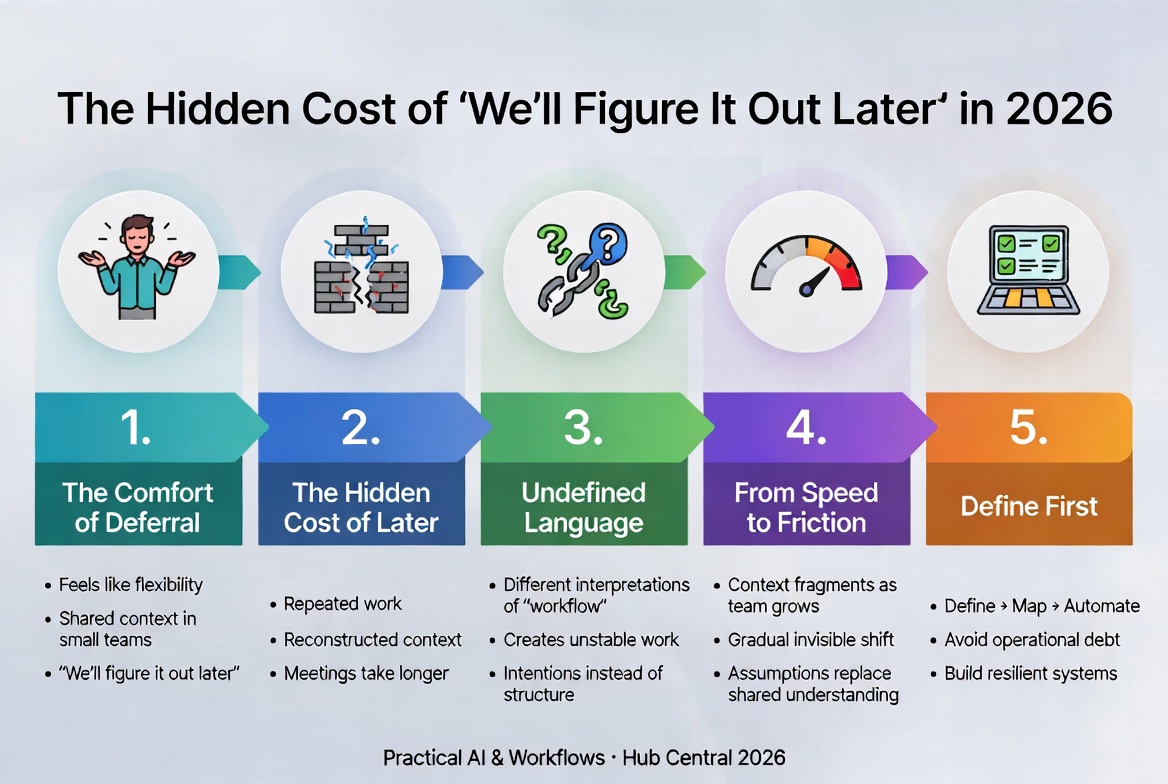
The Comfort of Deferral
In small, fast-moving teams, deferral feels like flexibility. Everyone shares the same context. Coordination happens in real time. Why slow down to document something everyone already understands?
The reasoning only works while those conditions hold. Shared context fragments as the team grows. New hires don’t carry the original conversation. Implicit logic becomes illegible. “Later” simply delays the moment when those assumptions break.
The Hidden Cost of “Later”
The costs don’t arrive as one dramatic event. They accumulate quietly in the gaps between what was assumed and what actually happens:
- Decisions get made twice — or three times — because no one recorded the first one.
- Work gets redone because output criteria were never stated.
- Two people solve the same problem in different ways because ownership was never assigned.
- Meetings that should take ten minutes take forty-five because the group must reconstruct context first.
None of these moments feel like structural failure. They feel like normal friction. That is precisely what makes deferred decisions so dangerous.
Undefined Language Creates Unstable Work
When a team says “let’s set up a workflow for that,” people often hear completely different things: a checklist, an automated sequence, or a loose convention.
A workflow, defined precisely, has four load-bearing parts: a clear trigger, a defined sequence, explicit ownership, and a known output. Remove any one of them and what remains is not a workflow — it is an intention.
Teams that operate on intentions move fast until they don’t.
The Gradual Shift from Speed to Friction
At two or three people, informal coordination is genuinely efficient. As the team grows, context fragments. Institutional knowledge lives in individuals rather than in documented process. The team stops operating on shared understanding and starts operating on assumptions about shared understanding.
The shift is gradual enough to be invisible — until it isn’t.
When Deferral Becomes Structural Debt
Every deferred decision is a small withdrawal from the team’s operational capacity. Collectively they form a substrate of ambiguity that the team must navigate on top of every other piece of work.
This operational debt becomes visible under two conditions: growth and pressure. Growth multiplies handoffs. Pressure removes the slack that was absorbing the cost.
See also: Why Most Teams Misunderstand Automation
Why This Matters Before Automation or AI
There is a tempting sequence: build processes informally, move fast, then automate once things are “running smoothly.”
The problem is that automation (or AI) does not introduce clarity. It executes whatever logic it is given. If that logic is ambiguous, automation simply operationalises the ambiguity at speed and at scale.
The correct order is always: Define → Map → Then automate or add AI.
See also: When Should You Introduce AI Into a Workflow
See also: Mapping Your Existing Workflow Before Using AI
See also: A Step-by-Step AI Integration Checklist for Small Teams
Next in Series: Part 3: Mapping Your Existing Workflow Before Using AI
Keep Reading
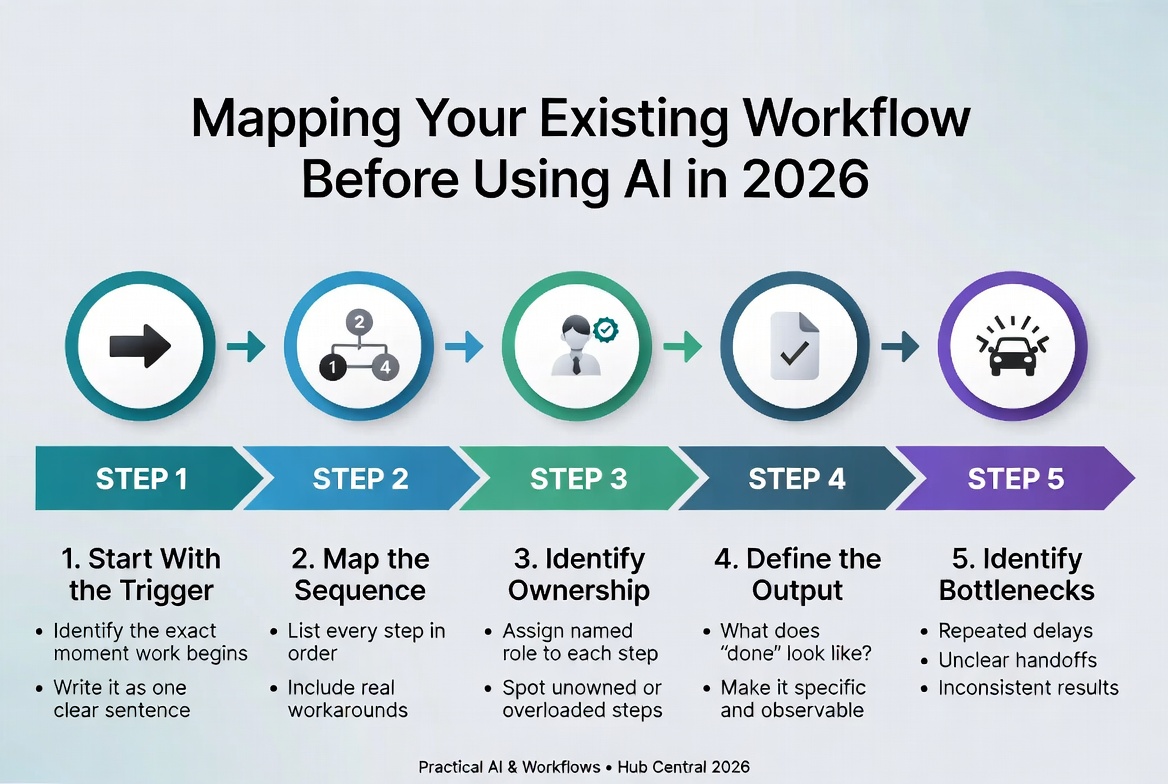
How to Map a Workflow Before Using AI | Hub Central
Learn how to map a business workflow before introducing AI, identify bottlenecks, separate automation from AI, and design human-in-the-loop processes.
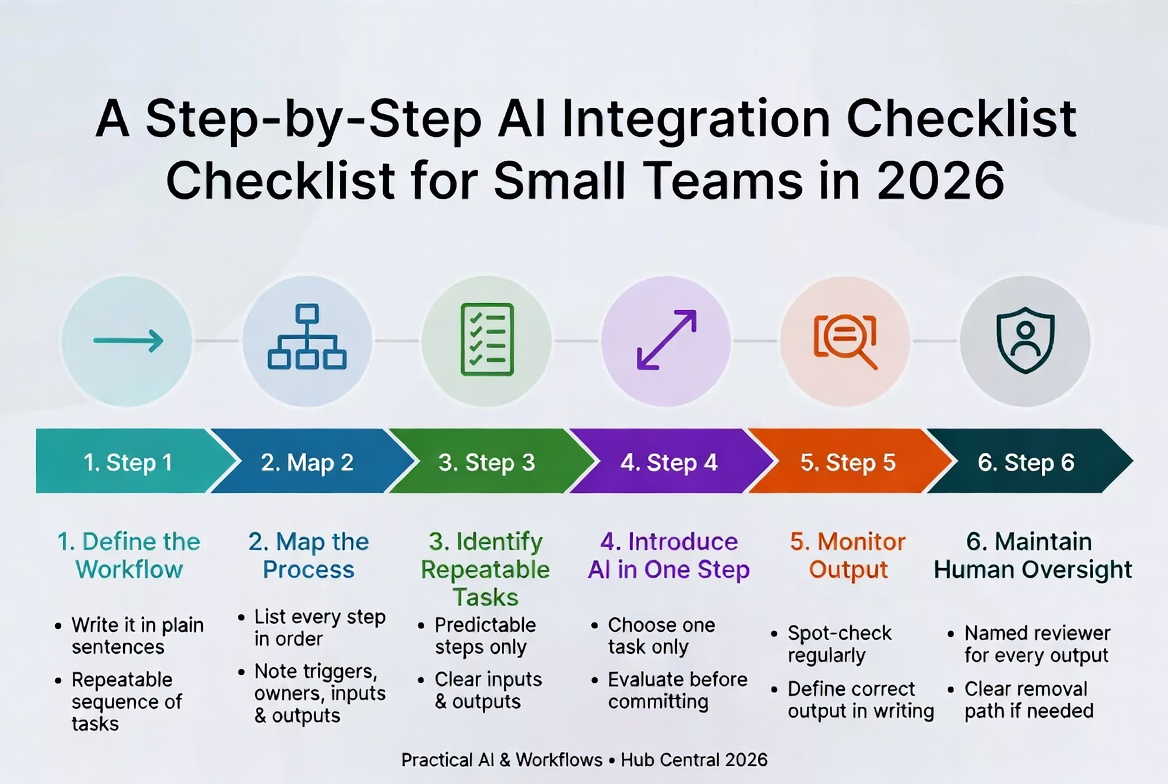
A Step-by-Step AI Integration Checklist for Small Teams in 2026
A disciplined six-step framework for adopting AI without losing control. Define the workflow first, map it, then introduce AI one step at a time – so you actually trust the results.
About Okel Dijital Team
Written by the Hub Central editorial team. We test real AI workflows and WordPress processes to help small teams work faster and smarter.